The Problem We Don’t Talk About Enough
For decades, education has followed a predictable pattern—textbooks, exams, grades, and repetition.
While this system has created academically strong individuals, it has also left a critical gap.
Many students graduate with knowledge but lack the ability to apply it in real-life situations. They can solve theoretical problems but struggle with decision-making, communication, and adaptability.
This raises an important question:
Are we preparing students for exams—or for life?
What Teaching Beyond Textbooks Really Means
Teaching beyond textbooks doesn’t mean eliminating traditional learning. Instead, it means expanding it.
It’s about shifting from memorization to application, from passive learning to active thinking, and from marks-driven success to skill-driven growth.
This approach focuses on developing individuals who can think independently, adapt to change, and navigate real-world challenges effectively.
Because in reality, life doesn’t follow a fixed syllabus.
Why Real-Life Skills Are the New Currency
In today’s rapidly evolving world, the definition of success is changing.
Industries are transforming, technology is advancing, and job roles are constantly evolving.
Employers today are not just looking for degrees—they are looking for skills.
The ability to think critically, communicate effectively, collaborate with others, and adapt quickly has become more valuable than ever.
Skills such as emotional intelligence, financial literacy, and problem-solving are now essential for long-term success.
Education systems that fail to incorporate these skills risk leaving students unprepared for the future.
Practical Ways to Shift Beyond Textbooks
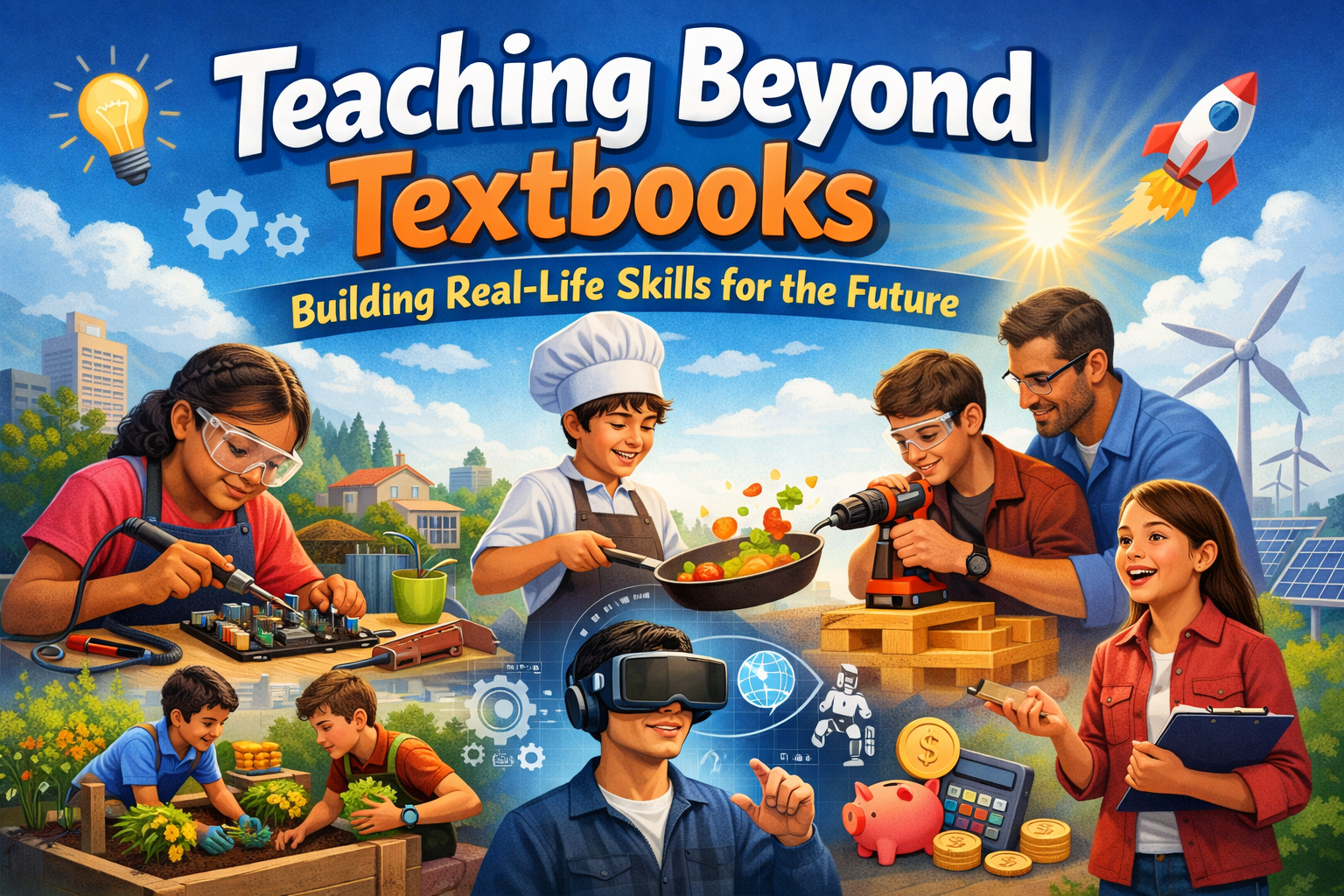
One of the most effective ways to transform education is by integrating real-world context into everyday learning.
Concepts become more meaningful when students understand how they apply in real life. Case studies, current events, and practical scenarios can make learning more engaging and relevant.
Encouraging curiosity is equally important. When students feel safe to ask questions and make mistakes, they develop confidence and creativity.
Communication is another critical area. Giving students opportunities to present ideas, participate in discussions, and work in teams helps build confidence and clarity of thought.
Integrating life skills into education is no longer optional. Teaching basics like financial management, time management, and decision-making prepares students for real-world responsibilities.
Experiential learning also plays a key role. Internships, projects, and hands-on activities bridge the gap between theory and practice, helping students gain practical exposure.
A Shared Responsibility
Transforming education is not the responsibility of educators alone.
Parents need to shift their focus from marks to skills.
Schools need to create environments that encourage exploration and innovation.
Institutions must embrace modern approaches rather than relying solely on traditional methods.
Only through collective effort can we build a system that truly prepares students for life.
The Future of Education
The future belongs to individuals who can think independently, adapt quickly, and continuously learn.
Knowledge will always be important—but the ability to use that knowledge effectively is what truly matters.
Education must evolve from being information-driven to being transformation-driven.
Textbooks can teach you what to think.
But real life demands that you learn how to think.
So the question remains:
Are we equipping students with knowledge alone—or with the skills to thrive in an unpredictable world?
What’s one real-life skill you believe should be taught in every school?